TWO By Jody Husted
Before coming to Ian, my horse didn't seem to be fluid in his turns.He felt stiff + uncomfortable. Almost like he didn't want to turn. After coming to Ian it's like riding a totally different horse! He feels free and comfortable. My times are quicker and I am confident with how he runs and feels. I like that Ian shoes my horse to the way he is built.
3 Tools Your Farrier Should be Using: Part 1-Caliper
Would you hire a carpenter that never used a measuring tape, a level, or a square?


The following are 3 tools your farrier should be using. I've been at this for 30 years, regularly deal with difficult cases, and yet with every horse, every foot, every time, I measure with all three of these tools.
1. Caliper
2. hoof guage,
3. T-square
1. Caliper
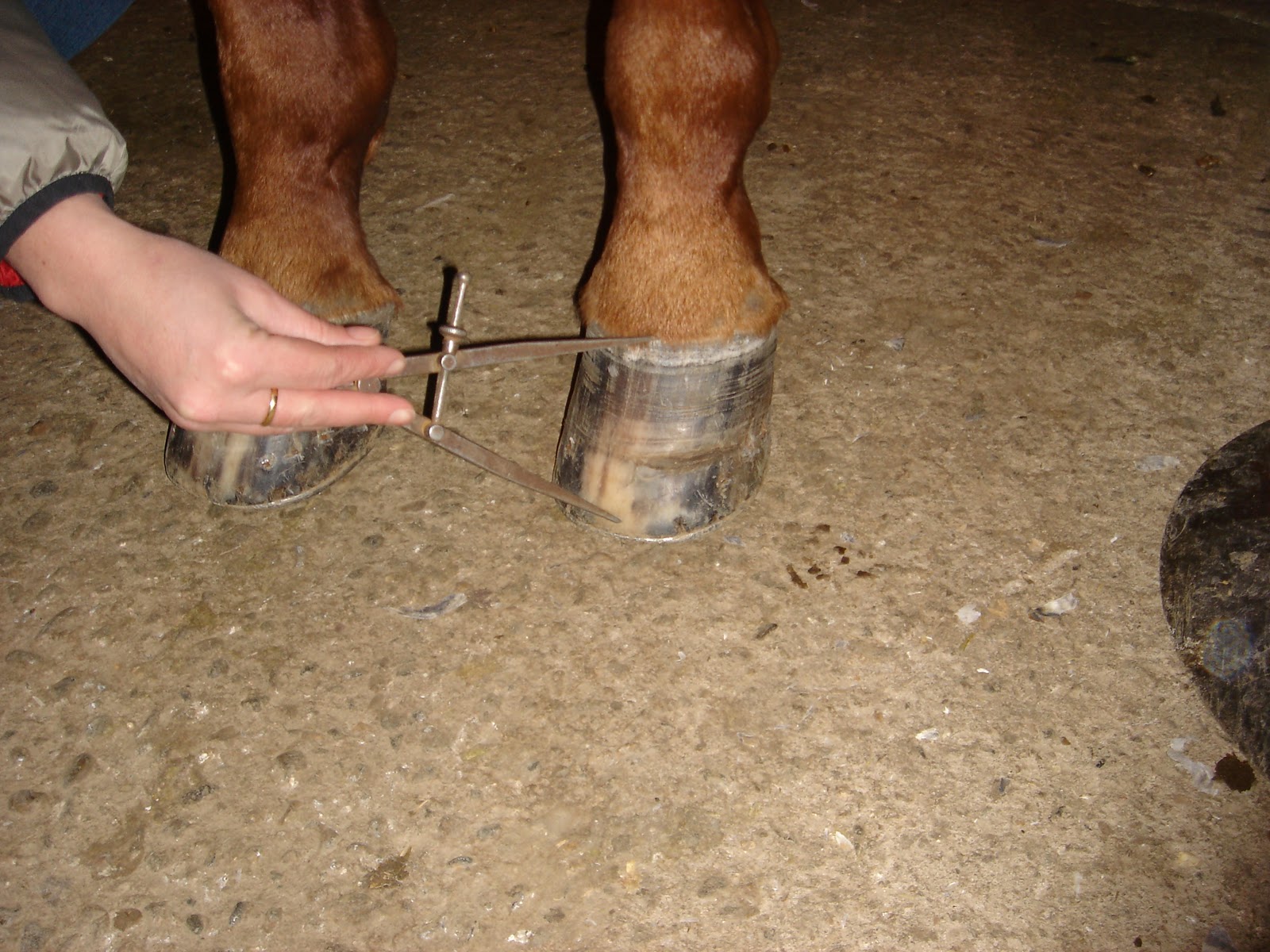
Used to measure the toe length. Both front feet should be the same and both back feet should be the same. Although the fronts may be different than the backs.
Why? Well think of it it this way. On your own two feet, if you were wearing a shoe that fit and one that was longer on the other foot not only would it be annoying but it would bother your walking and eventually make you sore. It's the same for your horse.
Also, in a horse, a 1/4 inch of toe-length can make a 5 degree difference in the angle. An 1/8 inch can make a 2 1/2 degree difference. Do you think your farrier can eyeball an eighth of an inch? For us, that might be like wearing a flat shoe and one with a one inch heal. We won't be performing our best so how can we expect a horse to, whose angles are affected by his toe-length. More on angles in Part 2: The Angle Guage.
3 Tools Your Farrier Should be Using: Part 2-Angle Gauge

The Angle Guage

The angle gauge has to be held tight to the foot .

We don't want to walk with two different heights of heels on our shoes. Also the horse has 7 joints between his coffin bone and his elbow. Being two different angles can put stress on their joints.
I like to check angles on both fronts to see if there is any difference before I start. This gives me an idea if I should take off toe or heel.
3 Tools Your Farrier Should be Using: Part 3 T-square

The T-square

A great tool when correctly used
.

Hind shown from laterial view
. 

Hind shown from rear view

Shown on left front from lateral view.
This tool checks the medial lateral balance of a foot (if the hoof is high on the inside or or outside). It is made so that the top rests on the cannon bone..... and goes down parallel with the horse's cannon bone. The foot is viewed over the T-square. Level the foot to the T-square. It is very important to make sure the shank is straight with cannon, the T is not tiped to either side.
Sometimes a farrier will think part of the hoof should be trimmed or filed a certain way and makes a mistake but this tool never lies and will show exactly what needs to be done to level out the foot.
Sometimes a farrier will think part of the hoof should be trimmed or filed a certain way and makes a mistake but this tool never lies and will show exactly what needs to be done to level out the foot.
This horse was sore in the hocks and stifle (can you blame him?) but came sound as soon as he was leveled out.

(left hind)


(after correct balancing)


The average length from the ground to the elbow is 3 feet.
If the average foot is 5 inches wide (side to side) and you are a sixteenth of an inch out at the foot (eg. high on the inside) you will be nine sixteenths out at the elbow. When you consider there are 7 joints in this part of the leg it's no wounder horses get sore. This is also the same on the hind leg.
I was asked how the T square would work on horses with crooked legs.
The T square will balance the foot to the natural bone structure of the horse.
This will make a horse sound 99% of the time, if it is used right.I have clients that have horses with deviations and rotated cannon bones, in the same leg that were sore from farriers trying to make them stand straight.After balancing them to the T square they became sound.
If the average foot is 5 inches wide (side to side) and you are a sixteenth of an inch out at the foot (eg. high on the inside) you will be nine sixteenths out at the elbow. When you consider there are 7 joints in this part of the leg it's no wounder horses get sore. This is also the same on the hind leg.
I was asked how the T square would work on horses with crooked legs.
The T square will balance the foot to the natural bone structure of the horse.
This will make a horse sound 99% of the time, if it is used right.I have clients that have horses with deviations and rotated cannon bones, in the same leg that were sore from farriers trying to make them stand straight.After balancing them to the T square they became sound.
Front view
When viewing a horse from front we have been told look at straight lines. Most horses are not built that way. When you look at the chest, the joint between scapula humerus and humerus elbow joint. If they are wider at bottom the horse will toe in. If they are wider at the top and narrower at bottom the horse usually will toe out.


This horse also has a deviation in his leg plus a rotated cannon bone. If you trim this horse to stand straight you will make him sore. But if you balance him to his cannon bone he WILL stay sound.

This x-ray shows a medial-laterally balanced foot the lines between the bones are even. On a unbalanced foot they will be compressed on one side and open on the other. This foot was balanced using a T square.
 When viewing a horse from front look for deviation rotations and offset knees.This will help you to see why the horse is toeing in or out.
 The black horse is a perfect example of diagram on the left.


These diagrams show the bone structure differences between toed in and toed out.
These three horses are wider at top so they toe out.


This horse also has a deviation in his leg plus a rotated cannon bone. If you trim this horse to stand straight you will make him sore. But if you balance him to his cannon bone he WILL stay sound.

This x-ray shows a medial-laterally balanced foot the lines between the bones are even. On a unbalanced foot they will be compressed on one side and open on the other. This foot was balanced using a T square.


Soundness

The main reason for this site is to try to get the message out to those who have horses with soundness issues, that it might not be as severe as you think, it could just be a problem with an unbalanced hoof.
Of course, some horses can't be fixed. But if x-rays are clean of breaks or bone spurs often it's just a problem that can be corrected by properly balancing the foot. It doesn't mean fancy shoes, just correctly trimming the foot.
That sounds simple but there is so much misinformation, a horse owner can get confused about what best to do to help their horse. This site is dedicated to helping horses by helping the horse owners gain a better understanding of correct hoof care.
What is a Balanced Foot

A balanced foot is medial laterally balanced to the cannon bone with the heels under the center of the cannon bone. The hoof angle should be the same as the pastern. Some horses will be steeper some lower. They should have some depth to their foot with frog support but not frog pressure.
The toe length should be the same on both front and on both hind. But may vary from front to hind.


Foot balanced with shoe.


Balanced to T-square
If all horses were trimmed or shod like this there would be very few lame horses.
Unbalanced Foot to Balanced in 1 Visit
This horse has severe foot problems, medial lateral out of balance and under run heels. When the heels are too far forward then the tendons and ligaments become weight bearing instead of the bone structure. This causes the bulbs of the heels to rotate downwards under the weight, from lack of support.

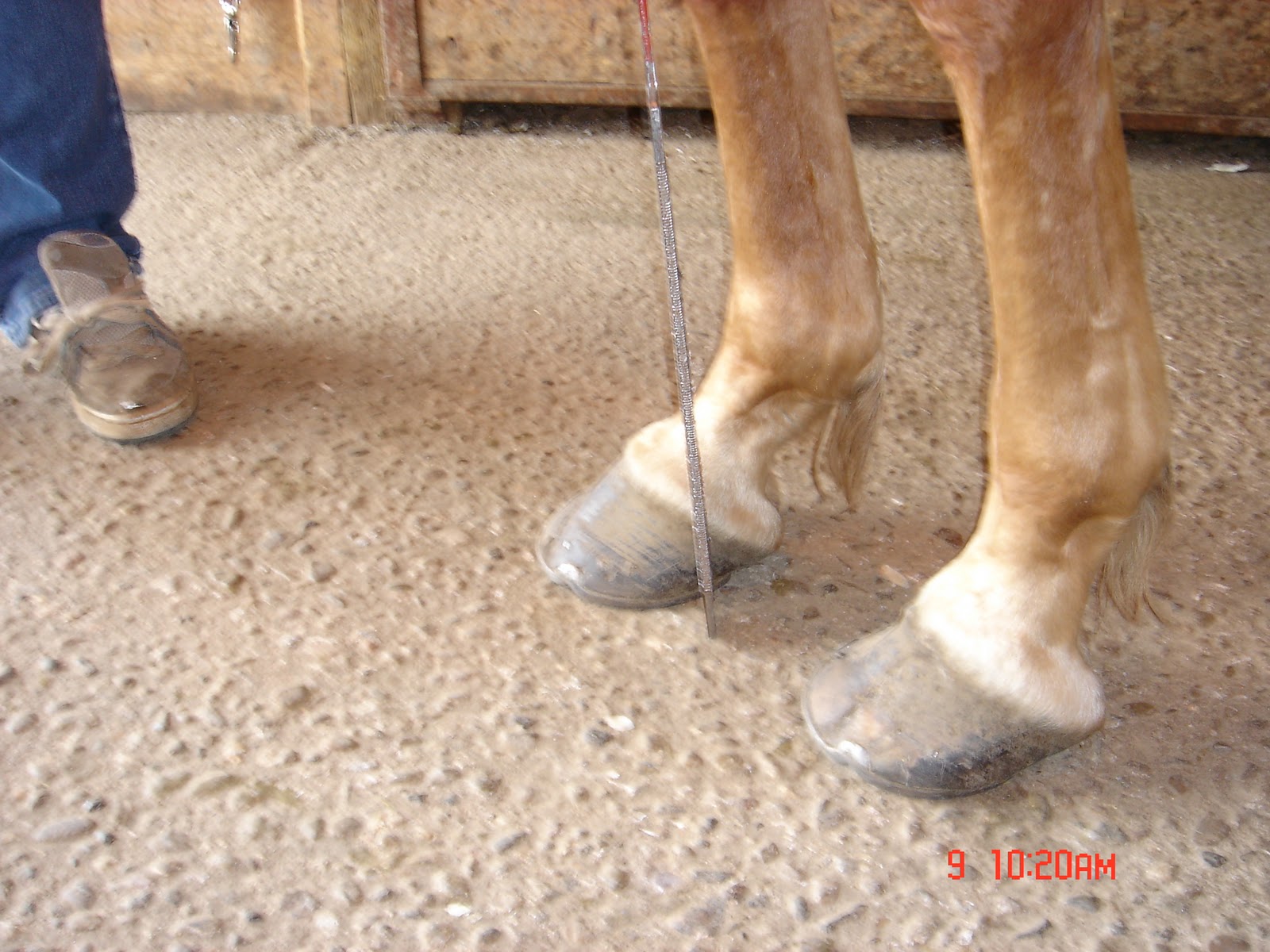


This shows a shoe that is too small, and not square with leg.

This shows right hind too small shoe, turned to inside of foot.

This shows severe cracks from improper balance,
due to long toe and low under-run heel

The same feet as first picture after medial lateral balance and shortening the toe.

Under Run Heels

A

B

C

D

E

What do pictures A, B, C, D, and E all have in common? Under run heels. A, C, and D all have low, crushed heels. B and E have high heels but thay are still too far forward. The rasp shows how much too far forward the heels are)
F

G
F and G show where the heels should be, in line with cannon bone.


This is a good example of a shoe that is to small. Drawing the heels forward. It also causes the heel crumble under weight.


This shows a foot balance to pastern joint, pastern and foot are at same angle
Subscribe to:
Posts (Atom)