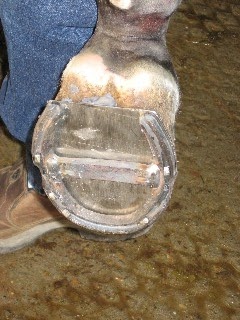
Toe + Quarter cracks

I think the main reason for cracks starting at the ground is unbalanced feet. Due to lack of or improper trimming. Cracks that start at the top are usually from abscess or puncture. This can be from small grains of sand working up the white line.

                                                                    Quarter crack
If you have a crack starting at the ground you can usually stop it by trimming or shoeing.
These cracks can also be caused by under run heels. If your horse has a curved hair line looking from medial or lateral view they will quite often break out at the hair line directly above where the heel actually makes contact with the ground. This is caused from lack of support to the buttress of heel . These will usually heal if you can get the foot to proper balance. Cracks that start at the hair line should never be clipped at bottom. This will make them worse. To fix a crack that starts at the hair line the best way I have found is to carefully stitch with a horse shoe nail. Just drive nail through the crack side ways and clench then rasp nail head down till smooth. You have to know what you are doing because you can quick them.


Some farriers will use router and take all hoof wall off in the crack. I have seen this over done causing more damage to the foot. I like to use the KISS method as much as possible.


This shows a toe crack with a stitch in it.
It is very easy to do and works very well.
Any time you have a crack at the hair line you do not want to clip the shoe because the foot will keep expanding at the top and never heal. Even just shoeing will restrict expansion at the ground so the top will not heal.
                                                           Putting a stitch in crack

Broken Coffin Bones

Broken coffin bone right hind. This horse heeled up a 100% and is being used as a lease rider's horse. After a whole year off they started riding him and he is good now. 

Lateral view shows no cracks.


Rear view shows crack down center.


  Front view shows crack off to lateral side of foot.


  Shoe and clip parallel to the break.

Add bar directly underneath the break

Make a stainless steel pad,


 put sole putty under pad but be sure not to use too much,
Make sure foot is squared with the cannon bone.


 I have had 100% success using this method.

Navicular

Navicular is an innocent bystander. Quite often a horse will be sore in center of the frog but have a clean x-ray.  This is called navicular syndrome. Research has shown this is most often soft tissue damage. I believe this is caused by under run heels combined with contracted heels.


This I think is caused by shoeing with too small of shoes and the old 'long toe, low heel'.
This way of shoeing does not properly support the elastic parts of the foot which is for shock absorption.


If you look at these feet, the one on left has very little digital cushion. The one on right has way more depth to it. The one on left has under run heels. The one on right dose not. Thus THE DIFFERENCE!


This picture shows a navicular bone with bone spurs on both sides of the navicular bone. Even though this horse has true navicular with proper balance we have been able to keep him sound for 7 years.  Refer to Grey and to [Henry still to come]. I believe that if we keep these horses balanced properly they can be maintained indefinitely.

I'm not saying all navicular horses can be helped. But if we can help some, it is worth it. Proper balance simply helps most horses.
                                                           Grey with balanced foot.

Henry
Henry first came to me the end of June 2003.He had been to Okotoks vet clinic.
He was diagnosed with navicular.He had bone spurs on both sides of his navicular, on both front feet.The prognosis was not good .They told Sue that she might get one more year out of him.Henry had severely under run heels,long toes as well as contracted heels.His frog was almost nonexistent.
                                                     Right front with  low angle.
.                                                                                    
Left front with low angle.


                                                            This shows navicular spurs.
                                  This is a xray from Dec 4  2008 you can see there is no change.
Henry was at a 45% angle. Witch is lethal to a horse .He also had way to small shoes on turned in at the heels . The first time I put shoes on him I put a 6 % wedge on him and put the heel back under his cannon bone where it should be.I used a wedge pad with sole support to get his frog working again.Henry showed improvement right away.The first challenge was to get his heel back under his cannon bone where it belongs. 
Once this was done I slowly started taking the wedges off till he was just in a shoe.We had Henry re. xrayed in Dec 2008 there was no change from his 2003 xrays.This goes to show proper balance can make a big difference.Henry is still going today March 2011.

                                              This xray shows proper alignment of bone column.

Hocks

 We all hear about horses getting their hocks injected. I believe that the main reason for this is from trying to force them to stand 'straight'. The age old standard is that horses are supposed to stand with hind legs facing straight forward. But when you start to understand the proper bone structure, this is not right. 

Most horses stand naturally toed out.

Why? If you look at these horses they all stand with their stifle wider than their point of buttock. I believe this is normal for most horses. Therefore they should stand with their legs pointing the same way as their femur. This is actualy correct if you are balancing to the bone structure.


If you look at the horse from behind, the pelvic bones are the widest point (H). From this point they narrow to the point of the buttocks (B). From there they widen back out to the stifle joint (S).


This tells you that the leg and foot should be at the same angle as the femur. This means the cannon bone and foot should be at the same angle.


This illustrates femur, tibia, and cannon all in alignment.

This is a good example of hind leg high on inside turning foot to inside.
This is the same foot centered with leg. Shows balance and suport of bone column.


(Hind legs both high on the inside)

Farriers have been told to leave back hooves high on inside to make them stand straight (toes facing straight forward).

This is devastating to the horse. It puts pressure on the pastern, fetlock, and hock. I have seen horses with hock problems come sound just by balancing their feet to the cannon bone (using the t-square).

This is a balanced foot. This should be done front and hind.

I believe that hock injections could almost be eliminated by proper trimming and shoeing.

RED FLAG

The best way to keep your horse sound is to balance his feet!
Things to watch for.
My farrier says he just has bad feet.
My farrier does not need to measure; he says he has a good eye.
Hoof gauges only work on horses with good feet.
You would have to have a different T-square for every horse.
When your farrier says: I think a horse is balanced if you have done him a couple of times and he is not lame. And the owner is not complaining.
We will have to make a special shoe and I am the only one that can do it.
Be aware of gimmicks and quick fixes.

3 Ways to Get and Keep a Good Farrier (Guest Post-CCC)

I feel privileged to be able to help Ian with his desire to get some good info out there. A lot of farriers will tell you a lot of different things, but this is a farrier I trust, have watched do miracles, and can recommend as someone who knows his stuff.

Something I thought I could add is a few things to do to get and keep a good farrier. Long-time horse owners realize that a good farrier is worth his or her weight in gold and it's to your advantage to treat them like it.

1. Hauling- My advise is: if you want to get or have a good farrier and he wants you to bring the horse to him, just do it. It's honestly worth it.

Ian, for example, has an insulated heated barn to work in,


great lighting,
and everything a farrier could possibly need for any hoof.There, he's comfortable, happy, and his home is just steps away.

We're luckier than lots of folks. We have an unheated barn with less than ideal lighting where he could at least be out of the weather, but it's too far to go back and get it if a horse needs something he didn't anticipate. If you were Ian, would you want to come to us?

So that's his advantages if we haul our horses but what are ours, the horse-owner's.

First is quality.
How much time are farriers going to take to do the best job possible if they are miserable: (getting rained on, dirt blown in their eyes, mosquitoes and flies pestering them, in hot sweltering sun, etc.)? They're going to hurry on your horse, right? They'd have to be super human to not want to.

Will interruptions that rob them of valuable time frustrate them?

If the lighting is bad will they miss something?

Will they have everything packed with them for any special needs? (I've had them forget to bring the right size nails, which seems pretty simple.)

Second is Willingness
Even though they might get paid mileage to drive to your place, I doubt they would dare charge you the full amount that it costs them in fuel, vehicle wear, and time sacrificed that could have been used to work on another client's horse. That all might make them less than willing to come.

If we think: "Farriers are like cats; they never come when you call and they don't go out in the rain," maybe we need to look at it from their perspective.

Good farriers are smart, well set up, and can afford to be choosy about their clientel. Don't miss out on a good farrier, just because it puts you out to haul your horse to him.

2. Don't Forget Appointments/Be on Time
Farriers don't get paid by the hour, they getting paid by how much work they do. A missed appointment for them means that much less money they makes that day. Good farriers don't have to put up with this. They are also usually booked heavily and will try to be patient knowing you are dealing with not always predictable animals but if you want to keep a good farrier make promptness a priority, tardiness a rare exception.

3. Train Your Own Horses
Do whatever it takes at home to train your horse to stand calmly and patiently to have their feet worked on. No farrier can afford to get hurt. They get paid for working, if they can't work it's a bad deal for them. Good farriers want to work on good horses. I bet if I asked Ian he would say he'd rather do a good horse than get paid more to do a bad one.

Hopefully that helps. I've learned the hard way that a good farrier is worth the extra effort,
CCC


Calbar & Lolli Pop (Guest Post-Patsy Watson)

I purchased a horse that seemed perfect for me, she was so quiet. But soon I started to notice things weren’t right. She stood with her legs further underneath her than normal (camped under), she would be in a sweat if tied up in the barn and lay down more than she should. When she walked her back ankles wobbled. A friend, who is knowledgeable about horses thought she seemed depressed and had heat in her left front pastern. She suggested we try taking her to Ian.

Our trip to Ian’s takes 4 hours and when we unloaded the mare she was soaking wet with sweat. Ian had me walk her around while he watched her and then he went to work. He said she had under run heals. He put shoes on her and said she shouldn’t be ridden for awhile. After a few months he told me the more I rode her the better, as it would get the blood circulating in her foot and help with the healing.

Over the next couple of years with regular trips to Ian this horse health transformation has been wonderful to watch. There is no wobble in her ankles, she stands normal, she has energy, and her hair coat is shiny. She often is the leader taking the herd out to the pasture. When we unload her at Ian’s she is completely dry.

We believe this is all a result of her feet being properly trimmed and balanced.

We have since purchased another horse with the same problem (this is a common problem we have come to understand). She also had white line disease. 


She ended up with an abscess in her left front hoof. It burst and her hoof had a crack running the length of her hoof. Ian had to put a stitch in the crack and it has now totally healed. The pictures show her crack in her hoof after the abscess.


This one shows it healed up. I also just wanted to say, the day Ian put the"stitch": in her hoof, I must have looked worried, because I remember Ian saying to me, "If I had a dollar for everyone of these I have done I would be a millionaire". And of course it worked wonderfully as you can see by her hoof now.

When we first had this horse she would crouch down when she was mounted. She no longer does that.

Ian believes in a properly trimmed and balanced foot. For Ian, it is all about the horse. We have seen the overall health of our horses improve dramatically with regular trips to Ian.

Thanks Ian for caring.
Bob and Patsy Watson

(Guest Post-Lynette Brodoway)

Ian has been taking care of my horses' feet for over 10 years. Because of his knowledge, experience and commitment to the well-being of my horses, I have very few lameness issues. His dedication to this industry is commendable and very much appreciated. Ian's integrity precedes him in everything he does. Every accomplishment achieved with my horses is in part thanks to Ian.

Proverbs 1:5 A wise man will hear and increase learning, and a man of understanding will attain wise wisdom.


Grey (Guest Post-Kevin Schreiner)

In the summer of 2008. I hurt my horse at a rodeo. I took him to the vets and they said it was soft tissue damage to turn him out. I turned him out for a year then back to the vets. They found a bone spur on his navicular and said he would need regular injections and would never be sound. I started getting his feet done by Ian Zoerb. With no injections he went on to win the 2009 team roping at the Canadian Finals. He is still sound today.
This shows greys left front in balance, this is the reason for being sound today
Note; When Kevin first brought Grey to me he had under run heels and was out of balance medial lateral.I believe that these are the main causes of navicular.

Doc Lindy (Guest Post-Marti Fuhriman)

In the spring of 2009, I had the privilege to become one of Ian's regular clients. I would not have imagined that using the 'tools' that he does would make such a noticeable difference in the overall soundness of my horses. I had one horse in particular that had under run heals and in the first shoeing I could see major improvement. By using the T-Square for better accuracy to ensure a balanced foot not only did my horses travel better but the regular "adjustments" needed in the shoulders, pelvis and hips almost disappeared completely in a couple resets. If they are level and balanced at the bottom - there are few problems at the top.
Thank you Ian for your care and dedication to your industry and on a personal note for keeping my horses sound and running at the top of their game.

Marti Fuhriman & Doc Lindy: 2009 Alberta Barrel Racing Association Open High Point Champion

GW (Guest Post-CCC)

This is the story of a fine old horse and a how much a good farrier can help.

GW got injured when we lent (never lend folks horses) him to a fellow for his little girls to ride. He sliced his foot badly on the tin on their barn (dangerous dang stuff) while they were on holidays with someone else doing chores; no one noticed. When the fellow came home he noticed but didn't think it was important enough to do anything about it or let us know till much later.

By the time we got him back it was bad. The fellow was going to pay (but started complaining right away) and the vets had a horrific plan to cure this, so we brought him home. We weren't sure what to do. My husband said it wouldn't hurt to take him to Ian and just see if there was something he could do.

He and a fine young lady vet, Dr. Kirby Finkbinder, looked the situation over and his foot went from this.

 to this
to this

and finally to this, before we left that first visit


It took a lot of work on Ian's part after that and on our part too for well over a year but . . .

it was all so worth it. The sorrel with our grandsons riding is GW, now.